
Number Bonds to 10: What They Mean and How to Practise Them
What are number bonds to 10? See every pair, a clear explanation of part and whole, and four simple games that help children understand the missing number.
The homework says “practise number bonds,” and suddenly a familiar piece of addition sounds like something you should have studied before becoming a parent.
A number bond shows how a whole number can be split into parts. For number bonds to 10, the whole is 10 and we are looking at two parts: 7 and 3, for example, because 7 + 3 = 10.
The goal is for your child to recognise the relationship from either direction. If they can see 7 of the 10 counters, they can work out that 3 are hidden. If they know 7 + 3 = 10, they also have a way into 10 − 7 = 3.
All the number bonds to 10
There are six pairs if you count each pair once. Swapping the parts gives the other addition facts.
| First part | Other part | Addition fact |
|---|---|---|
| 0 | 10 | 0 + 10 = 10 |
| 1 | 9 | 1 + 9 = 10 |
| 2 | 8 | 2 + 8 = 10 |
| 3 | 7 | 3 + 7 = 10 |
| 4 | 6 | 4 + 6 = 10 |
| 5 | 5 | 5 + 5 = 10 |
The reversed facts are 10 + 0, 9 + 1, 8 + 2, 7 + 3 and 6 + 4. Five plus five stays the same. There are 11 ordered pairs when zero is included.
A useful pattern to notice: as one part grows by 1, the other shrinks by 1. You can slide a counter from one group to the other to show why the total does not change.
Explain it with ten objects first
Put ten counters, blocks or drawn dots where both of you can see them. Count them together. Separate four into one group and six into another.
Try saying, “There are still ten altogether. Four are here and six are there.” Bring the groups back together, then let your child choose a different split. Keep asking what stayed the same and what changed.
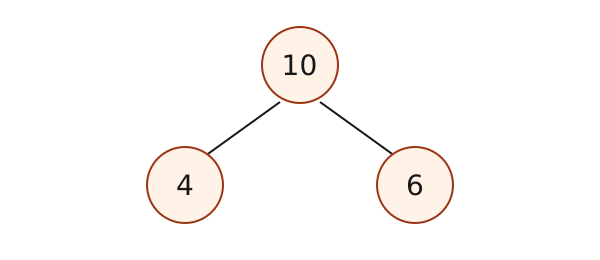
Next, draw a simple part-whole picture: 10 in one circle, with two lines leading to circles containing 4 and 6. Write 4 + 6 = 10 beside it. The objects, picture and equation should all describe the same ten things.
That last connection matters. A meta-analysis by Carbonneau and colleagues found average advantages for instruction using concrete manipulatives over instruction using abstract symbols alone, with results varying across studies. It supports using physical representations thoughtfully, not a claim that any toy automatically teaches addition.
Four games for practising number bonds
1. Hidden Counters
Count out ten counters. Ask your child to close their eyes while you hide some under a cup. Leave the rest visible. “There are ten altogether. You can see eight. How many are under the cup?”
Let them explain before lifting the cup to check. Then swap roles. If ten is too much to keep track of, start with five and work toward ten later. The important part is knowing the original total.
2. Fill the Ten-Frame
Draw two rows of five boxes. Fill some boxes with counters and ask how many empty spaces remain. With seven filled, there are three empty spaces: 7 + 3 = 10.
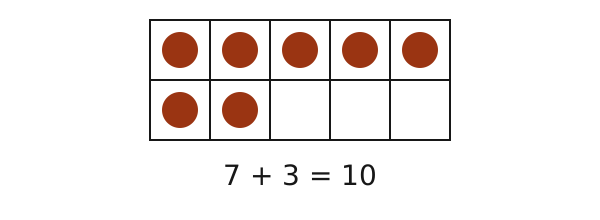
Keep the counters arranged in the frame rather than scattered around the table. After a few turns, ask whether your child can see the missing part without counting every empty box. Counting is still an acceptable way to check.
3. Find My Partner
Make eleven small cards numbered 0–10 and lay them face up. Point to a 2 and ask your child to find the partner that makes 10. Return both cards to the layout after each turn so every number stays available.
For 5 + 5, make a second 5 card or let the child name the same number twice. Do not accidentally make a game where the correct answer is missing.
Once the pairs are familiar, move to Make Ten with a regular deck. That version has several copies of each number but no zero, so it practises a smaller set of pairs.
4. You Be the Teacher
Write a missing-number equation, such as 6 + □ = 10. Offer an answer and ask your child to check it with objects or a drawing. Sometimes answer correctly; sometimes make an obvious mistake, such as choosing 5.
“That makes eleven” is a valuable explanation. Ask what would fix it. Keep the mistakes playful and easy to inspect, rather than trying to catch your child out.
How number bonds help with harder addition
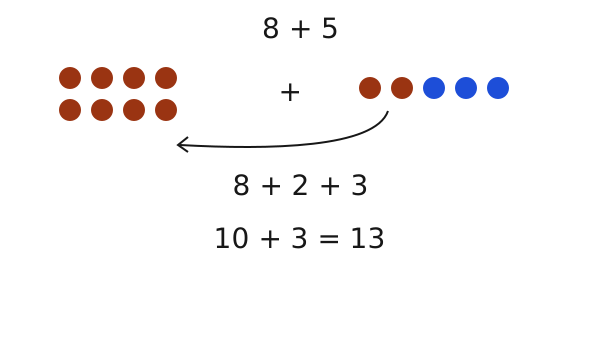
Take 8 + 5. Knowing that 8 needs 2 to reach 10 gives your child a route through the calculation:
- Split the 5 into 2 and 3.
- Add the 2 to the 8: 8 + 2 = 10.
- Add the remaining 3: 10 + 3 = 13.
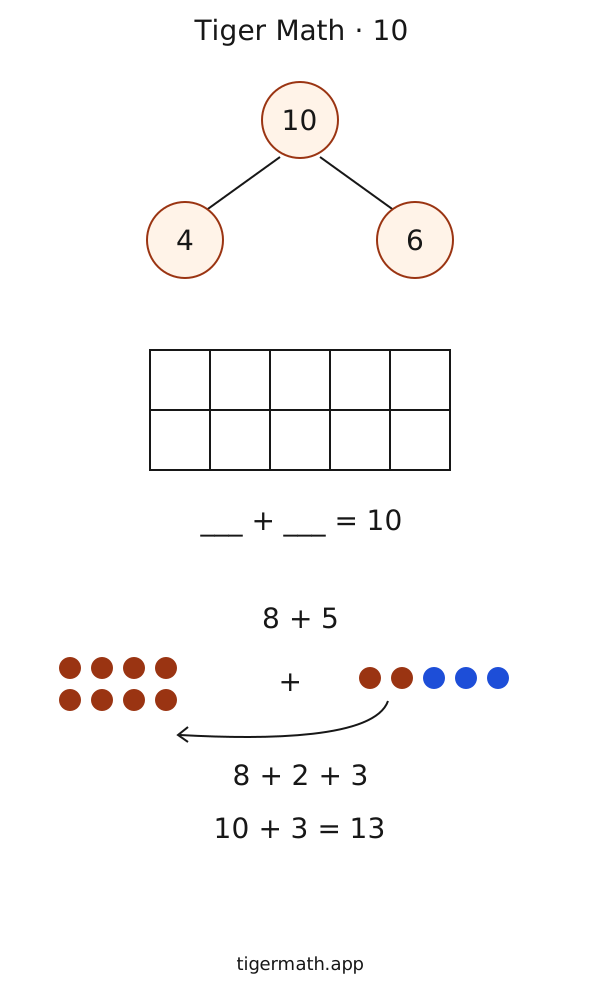
Download the number-bonds practice sheet: a part-whole diagram, a blank ten-frame and the make-ten example, ready to print.
Show this with counters before expecting the written steps to make sense. Move two counters from the group of five into the group of eight. Three remain; none have appeared or disappeared.
Making ten is one useful strategy. Your child may use another valid method, such as counting on. Ask them to show it, then compare how the two methods work. For the broader picture, read about number sense.
What if the pairs still will not stick?
First find out which part is difficult. Can your child count ten objects accurately? Can they split them and recognise that the total is still ten? Can they find the hidden group with the objects present, but not when the objects are gone?
Those are different starting points. If the idea is clear but recall is slow, practise two or three pairs and revisit them on another day. If the idea itself is unclear, spend more time making and combining the groups.
You do not need a timed test to discover this. Try, “Show me how you know,” and wait. Our short home-practice plan gives you a way to keep a useful note without turning the session into a scorecard.
Questions about number bonds
When do children learn them?
It depends on the school system and the child. In England, Year 1 mathematics includes number bonds and related subtraction facts within 20. Ask your child’s teacher which totals they are practising now, rather than using an age as a deadline.
Are number bonds just addition facts?
They describe the relationship behind the fact: a whole and its parts. Seven and three make ten; taking either part away leaves the other. That connection is useful even before the answer comes instantly.
Should we move straight from bonds to 10 to bonds to 20?
Check the smaller totals too. A child can recite pairs to 10 but still find the parts of 7 unfamiliar. Try a few different wholes, then ask the teacher what to work on next.
For today, ten counters and one cup are enough. Hide a few, let your child investigate, and give them the cup for the next turn.
Related reading
- US Grade Guides · 5 min read1st Grade Math: What to Practice at Home, With ExamplesExplore math for 1st graders with addition, subtraction, tens and ones, and simple measurement activities. Includes worked examples and answer checks.
- Math Activities · 5 min readSubtraction Games for Kids: Beyond “Take Some Away”Four subtraction games for kids using counters, number lines and missing-number stories, with worked examples and guidance on common mistakes.
- Learning Activities · 6 min readFive Math Games You Can Play With an Ordinary Deck of CardsTurn a deck of cards into five math games for addition, subtraction, multiplication and place value. Includes complete rules, examples and easier versions.
- Child Development · 6 min readNumber Sense: The Hidden Foundation Your Child Needs Before MultiplicationNumber sense is the invisible skill that separates children who find math intuitive from those who struggle. Here's what it is, how to spot gaps, and how to build it.
- Parent Guides · 6 min readBack-to-School Math Practice That Fits Into a Normal EveningA practical back-to-school math routine for ages 6–12: choose one skill, use worked examples, revisit it across the week and know when to ask the teacher.